How can urban design and planning research inform decisions across different geographical contexts, particularly where data and institutional resources are limited? In the project Applicability of EBDP in Different Planning Contexts and Scales, a team of researchers explored how Evidence-Based Urban Design and Planning (EBDP) methods could be adapted for use in different planning contexts.
EBDP methods help researchers assess how urban form and planning decisions affect social and economic outcomes. Many established approaches were developed and tested in contexts such as the UK and northern Europe, and often require extensive data and institutional capacity. The team investigated how these methods could be adapted for planning contexts in Cyprus, where data and resources are more limited, including through “lightweight” models designed to work with available data.
The study was conducted as part of TWIN2EXPAND, a research initiative focused on strengthening research capacity in EBDP at the University of Cyprus. The team publicly preregistered their study plan on the OSF and shared datasets on Zenodo, linking research plans to the outputs they informed. Their approach offers a practical example of lifecycle open science (LOS), in which research plans, outputs, and findings are made publicly accessible and connected so others can understand and build on the work.
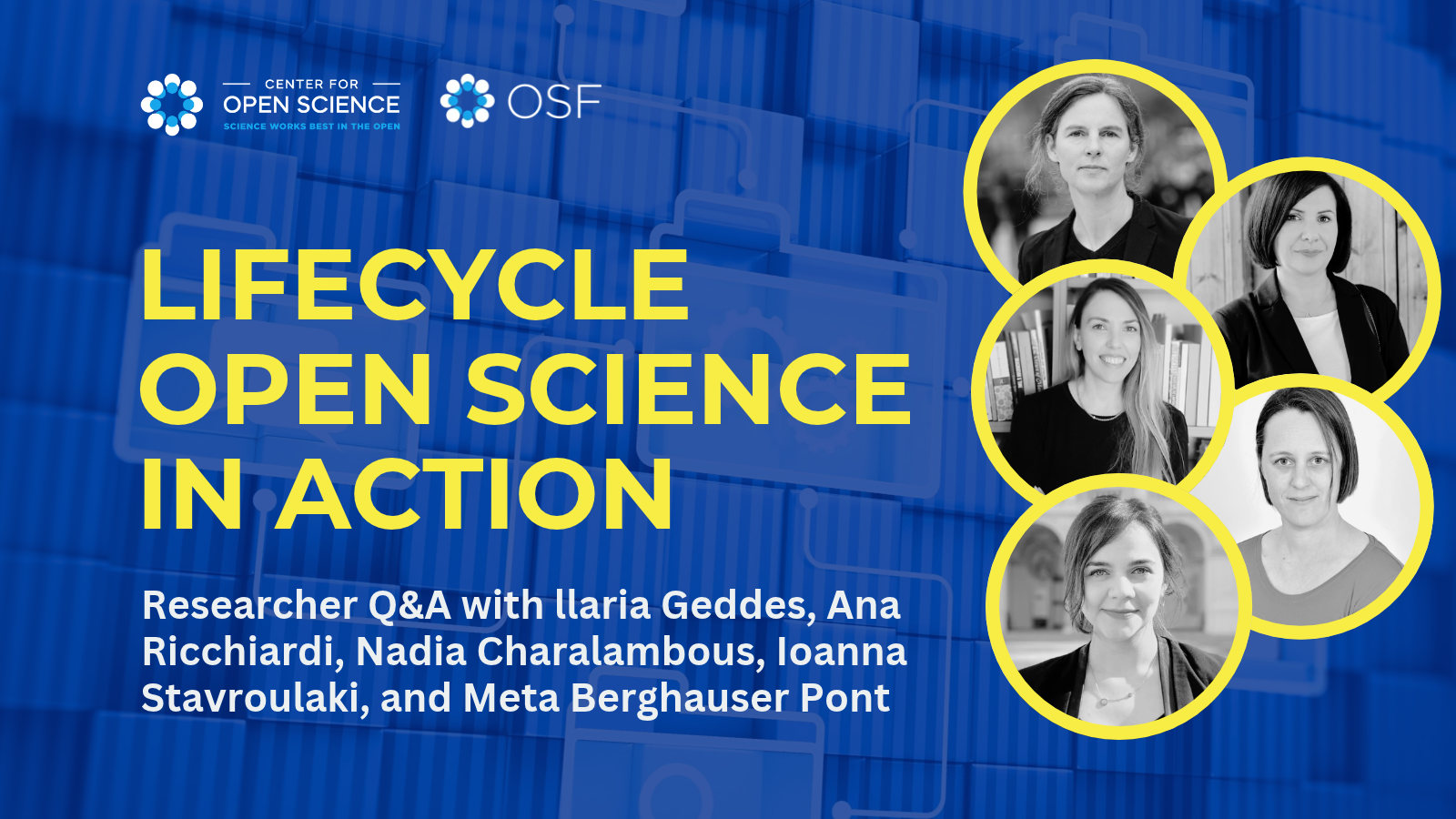
In this interview, Ilaria Geddes (Research Fellow, Society and Urban Form Lab, University of Cyprus), Ana Ricchiardi (Postdoctoral Researcher, Society and Urban Form Lab, University of Cyprus), Nadia Charalambous (Professor, Society and Urban Form Lab, University of Cyprus), Ioanna Stavroulaki (Senior Researcher, Spatial Morphology Group, Chalmers University of Technology, Sweden), and Meta Berghauser Pont (Professor, Spatial Morphology Group, Chalmers University of Technology, Sweden) discuss their process, considerations, and decisions related to preregistration, data management, and sharing research outputs across institutions.
Q: Can you share a brief overview of this project—what questions were your team hoping to answer, and what motivated it?
A: The general aim of the research project was to expand and facilitate the application of Evidence-Based Urban Design and Planning (EBDP) to urban design and planning practice across geographical contexts, updating its methodological framework to address the current environmental and social challenges in line with the global sustainability goals, and especially SDG11 (Sustainable Cities and Communities).
To achieve this, we addressed three interlinked research questions:
What are the challenges and barriers of applying existing EBDP methods (spatial models, KPIs, tools) focusing on social-economic performance, especially in contexts of limited data availability and institutional capacity?
How can lightweight spatial modelling be used to facilitate the adaptation of established methods of EBDP to planning contexts with limited data availability and institutional capacity?
What models, methods and tools can be used to facilitate the integration of social-ecological performance of urban form, such as the impact on human-fauna interactions?
Q: What led your team to document and register your study plan publicly on the OSF before beginning the work?
A: The research project was part of a broader capacity-building project. Increasing knowledge and capacity in open science was part of the broader objectives of TWIN2EXPAND. We had committed to preregistration at proposal stage to comply with and gain skills in open science best practice. Besides this commitment, we understood that the process would be beneficial to us, both in terms of detailing our research methodology but also for dissemination and impact.
After researching various preregistration platforms, we realised that there were big differences on what needed to be defined for studies that were entirely quantitative, for mixed methods studies or for those that included mostly qualitative components. OSF proved to be the most suitable option for our research approach.
Q: Your project draws on open datasets, government data, purchased datasets, and your own fieldwork. What considerations shaped how you documented, managed, and shared different types of data throughout the project?
A: A Data Management Plan was prepared at the beginning of the project and revised regularly. This acted as the main guiding framework throughout the project.
For datasets created as part of the project, whether the value of the dataset as an asset outweighed the value of open access as a way to exploit results, develop collaborations and increase visibility of the researchers and labs involved.
Whether the licenses for the data we would use would enable us to release secondary datasets, for instance linked to open-access publications.
For data collected as part of the research project, detailed documentation of the collection methods and process, to facilitate replicability and knowledge transfer.
For code, the use of GitHub as a secure backup, for version control and history, collaboration and visibility.
For datasets, the use of Zenodo as a repository.
Sharing primary and secondary data among different academic institutions with different protocols of data management.
Time-stamping was particularly important, especially for open-source data which are updated frequently and may not include a trail of previous versions of the datasets.
Q: Can you speak to what prospective documentation looks like in your field, and what value it has for your work?
A: For us it is mostly about publishing our hypothesis, research protocols, datasets and research methods. The value it has, especially working with large teams, is to agree on the scope of the project and the research activities to be implemented—in this sense, it also works as an action plan for the research. Additionally, it creates a baseline to measure the ‘success’ of a project—regardless of negative or positive findings—so it helps document results and feel more confident about reporting negative findings. Hopefully, it also makes the methodology reproducible, at least for the team involved. However, the extent of reproducibility by other researchers for the most qualitative aspects would require extremely detailed documentation, which is time consuming, but also not quite embedded within the OSF format.
Q: Your team has made multiple datasets publicly available on Zenodo, linked back to your registration on OSF. What do you see as the value of keeping those outputs connected to the original study plan?
A: Mostly it is for other researchers to understand in what context and for what purposes the datasets were created and used. It also documents what the methods planned at the preregistration phase produced as outputs. In combination with the published papers, this enables others to assess that the original research questions were answered satisfactorily.
Q: For researchers in urban planning and design who may be newer to open science practices, what would you say are the benefits of making your research plans, data, and findings publicly accessible and connected?
A: It has made the research process easier to manage and more transparent, both internally and externally. It has also provided greater visibility to the research and clearer linkages between the different research components.
Q: What advice would you give to researchers in your field who are just beginning to think about making their work more open and findable?
A: For the reasons above, it is worth putting in the time at the beginning of the project to go through the preregistration process. Making the work more open and findable specifically can only be an advantage to researchers in terms of both visibility and reputation.
Commitment throughout the duration of the project in thorough documentation of methods, outputs and results is needed. Without it, the work might be findable and open but not useful for other researchers to use, build on or even replicate.
Finally, it is very important to involve the whole research team from the start and to make sure that there is agreement on all key elements, especially the hypothesis and study design, as well as on what 'open' means in terms of method building, sharing, publishing, and documentation.

6218 Georgia Avenue NW, Suite #1, Unit 3189
Washington, DC 20011
Email: contact@cos.io

Unless otherwise noted, this site is licensed under a Creative Commons Attribution 4.0 International (CC BY 4.0) License.
Responsible stewards of your support
COS has earned top recognition from Charity Navigator and Candid (formerly GuideStar) for our financial transparency and accountability to our mission. COS and the OSF were also awarded SOC2 accreditation in 2023 after an independent assessment of our security and procedures by the American Institute of CPAs (AICPA).
We invite all of our sponsors, partners, and members of the community to learn more about how our organization operates, our impact, our financial performance, and our nonprofit status.