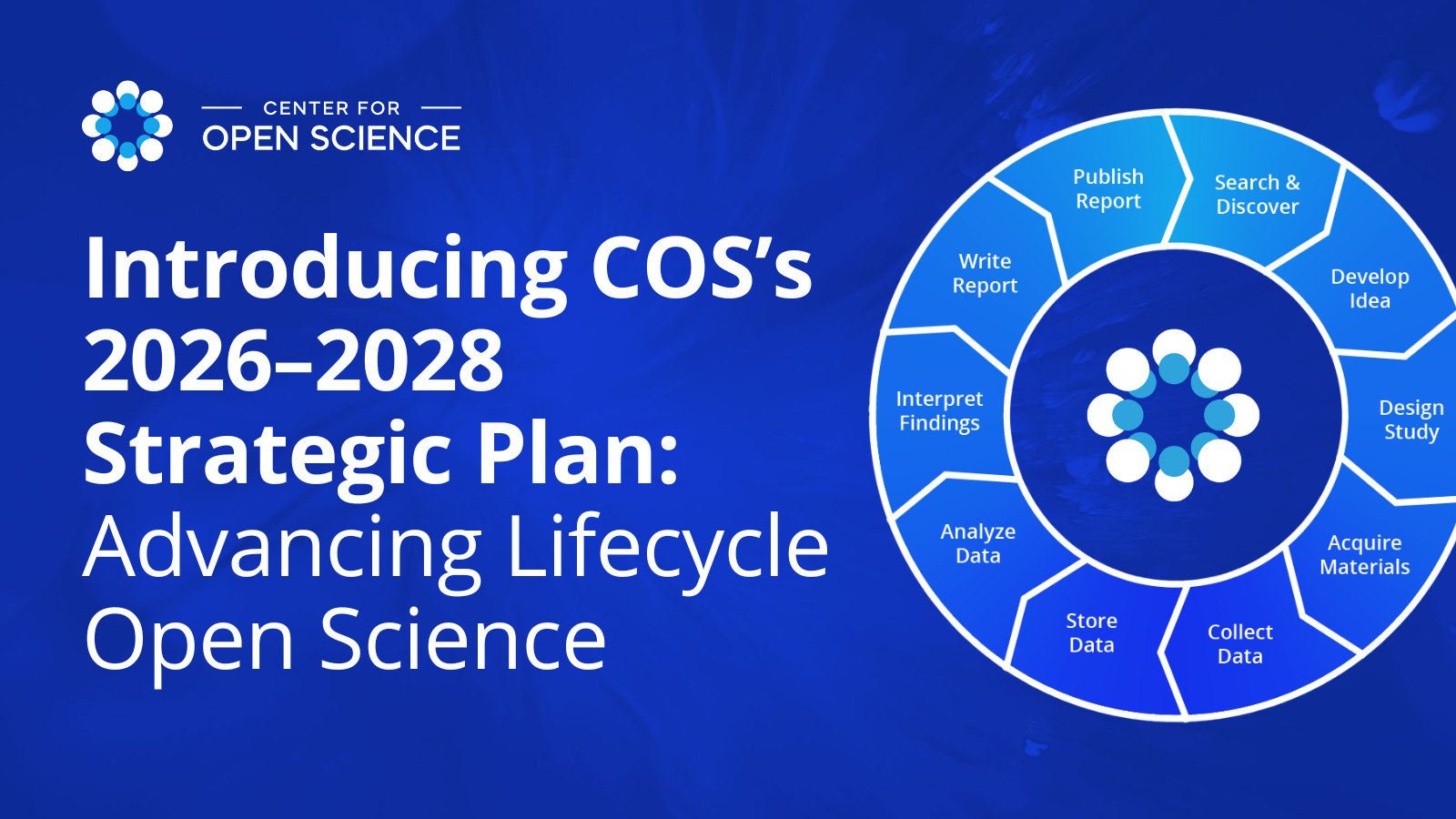
The Center for Open Science (COS) has released its 2026–2028 Strategic Plan, outlining a focused, three-year direction for advancing openness, integrity, and trustworthiness in research.
The research landscape has changed substantially since COS was founded in 2013. Once peripheral, open science has moved into the mainstream of research policy and publishing in many fields. And, a metascience movement has formed to continuously innovate and evaluate efforts to improve research culture and practices. The need for open science reform has shifted from getting researchers to do it at all to ensuring that they have the support and evidence they need to do it well.
Rather than expanding into new mission areas, this plan reflects a convergence of what we’ve learned over more than a decade of building infrastructure, generating evidence, shaping policy, and supporting communities. Over the next three years, we’re aligning our work around a single guiding direction: advancing Lifecycle Open Science.
The published paper is advertising for the conducted research. The actual research is the process and outputs underlying what is reported in the paper. Even so, those study plans, data, materials, and code are often missing from the public record, scattered across systems, or difficult to access over time. That makes research harder to evaluate, reuse, and build on.
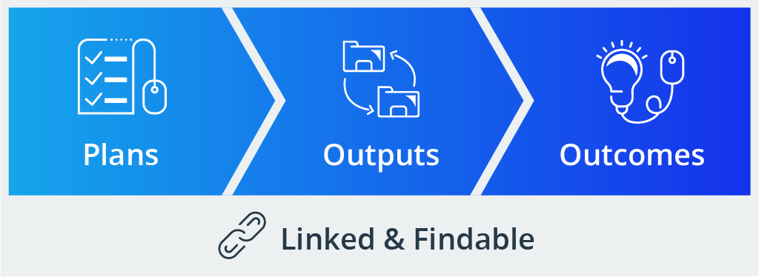
Lifecycle Open Science is research with publicly accessible plans, contents (data, materials, code), and outcomes that are linked and findable in a persistent, open location. Lifecycle Open Science keeps those pieces connected across the research lifecycle—from planning through reuse. This makes the foundations of research claims visible and accessible, helping researchers and other research consumers evaluate credibility, reuse materials, and better understand strengths, weaknesses, and uncertainty in the research record.
Lifecycle Open Science benefits everyone who relies on evidence.
For researchers, Lifecycle Open Science supports clearer documentation of methods and materials, reduces duplication, and makes it easier for others to verify, reuse, and build on prior work—speeding cumulative knowledge building.
For practitioners and public-serving organizations, Lifecycle Open Science makes it easier to see how a study was conducted and what outcomes were examined, helping decision-makers interpret findings and apply them appropriately in programs, services, and policy.
For the broader public, Lifecycle Open Science strengthens trust in research by making evidence more transparent and connected—so claims are easier to understand and evaluate, and decisions can be better informed by the evidence and appreciation of its uncertainty.
The strategic plan outlines three mutually reinforcing objectives for advancing Lifecycle Open Science:
|
Demonstrate Pathways First, COS will demonstrate pathways for Lifecycle Open Science by developing real-world case studies across disciplines, geographies, and stakeholder communities. These case studies will show how Lifecycle Open Science works in practice, identify enabling and constraining conditions, and generate evidence about what supports sustainable adoption.
|
Improve Pathways Second, COS will improve pathways for Lifecycle Open Science by iteratively strengthening the tools, infrastructure, training, and policy interventions that make it possible, easy, and worthwhile. A readiness-guided engagement model will inform where and how COS invests, recognizing that communities differ in their capacity and readiness to adopt Lifecycle Open Science practices. |
Promote Pathways Third, COS will promote pathways for Lifecycle Open Science through coordinated communication, partnerships, and capacity-building. Promotion in this plan emphasizes demonstrated value, co-creation, and sustained engagement, rather than advocacy alone.
|
Together, these objectives will show what Lifecycle Open Science looks like in practice, make it easier to do, and support sustained adoption.
Our work is organized by a systems-based Theory of Change that coordinates mutually-reinforcing action across open infrastructure, user-centered product development, community capacity and norms, incentives, and policy frameworks.
The 2026–2028 Strategic Plan positions COS to lead with focus, evidence, and coordination for advancing research credibility and evaluation. By demonstrating, improving, and promoting Lifecycle Open Science, COS will help embed transparency, rigor, and trustworthiness across the research lifecycle, partnering with researchers, institutions, funders, and policymakers worldwide to accelerate research progress.
Our thanks to the diverse community of researchers and research-supporting organizations that have led advancement of open science for more than a decade. We are grateful to be part of a community of practice that combines idealistic aspirations, pragmatic implementation, and pursuit of evidence to improve continuously and maximize impact.


A note on our mission statement: You’ll notice our mission statement now uses trustworthiness rather than reproducibility. This isn’t a change in mission—it’s a clarification. The term “reproducibility” has taken on multiple meanings across disciplines and contexts; “trustworthiness” more clearly captures what we’re ultimately working toward: research that can be understood, evaluated, and reused with confidence (see Nosek, Errington, Haber, Stankov, & Tyner, 2025 for more detail).

6218 Georgia Avenue NW, Suite #1, Unit 3189
Washington, DC 20011
Email: contact@cos.io

Unless otherwise noted, this site is licensed under a Creative Commons Attribution 4.0 International (CC BY 4.0) License.
Responsible stewards of your support
COS has earned top recognition from Charity Navigator and Candid (formerly GuideStar) for our financial transparency and accountability to our mission. COS and the OSF were also awarded SOC2 accreditation in 2023 after an independent assessment of our security and procedures by the American Institute of CPAs (AICPA).
We invite all of our sponsors, partners, and members of the community to learn more about how our organization operates, our impact, our financial performance, and our nonprofit status.