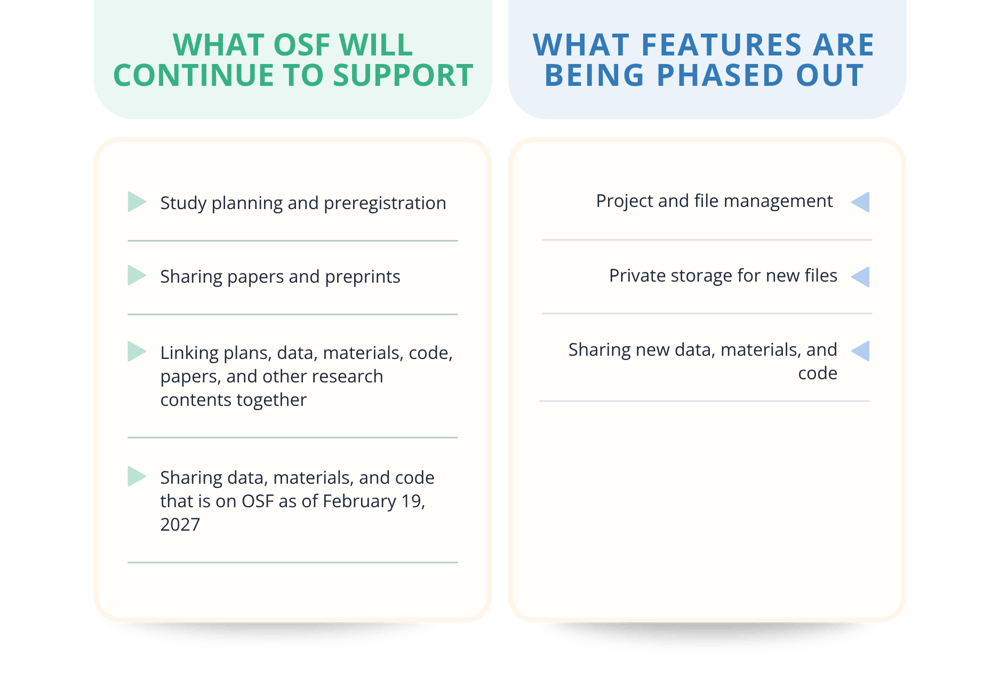
Starting November 16, 2026, no new projects or child components of existing projects can be created on OSF.
After February 19, 2027, all public and private OSF projects will become read-only. You will continue to have the same access, and all links and DOI identifiers will continue to resolve indefinitely.
We anticipate removing private projects in the future, and we intend to provide 12 months advance notice of that decision.
For guidance and recommendations based on the situations above, visit the OSF Projects transition help guides. The guides will help you understand what applies to your OSF content, what actions may be needed, and where to find more detailed instructions, including guidance on choosing an appropriate repository.

If you use the OSF to help students learn about open science practices, you can continue to do so, though you may need to adjust how OSF fits into your course. We’ve developed some guidance to support instructors through those adjustments.
Continuing with the current flexible, expansive OSF would require raising $4-5M per year for the next several years. In the present funding environment, we cannot expect that level of annual support (please see this post for more details about why these changes are necessary).
It is our responsibility to proactively support the persistence of the public scholarly record. This means we need to be honest about our limitations and constraints.
We hope this move will allow COS to focus on the areas where it can provide the strongest service, while working alongside other specialized open infrastructures to strengthen a more sustainable system.

As outlined in the product roadmap, OSF will focus on enabling researchers to prepare study plans and preregistrations, link related data, materials, and code wherever they are stored, and report associated outcomes, including sharing preprints and papers.
The open science movement has made enormous strides since OSF launched in 2012. There are now several other mature, effective infrastructures supporting open science. By narrowing OSF to the use cases for which it is uniquely suited and impactful, we can lean on specialized services to fill use cases that OSF no longer supports, lower maintenance burden, and allocate resources to improving the usability of a leaner service and supporting long-term discovery and access to publicly shared OSF hosted content. Rather than relying on a single platform to do everything, researchers will use a system of interoperable services. Each service—including OSF—can excel in its role while working together to reduce duplication, streamline workflows, and make open science easier to navigate.
Also, with OSF, we remain committed to the persistence of the scholarly record and to keeping publicly shared research objects and associated metadata persistent, discoverable, and accessible.
Visit the OSF Projects transition FAQs for answers to common questions about what is changing, why COS is making these changes, what will continue, and how the transition may affect OSF users and communities.

We are grateful to the OSF users and communities who have helped shape open science with us. COS is committed to supporting users through this transition and continuing to advance open, transparent, and trustworthy research. For additional questions, reach out to support@osf.io

6218 Georgia Avenue NW, Suite #1, Unit 3189
Washington, DC 20011
Email: contact@cos.io

Unless otherwise noted, this site is licensed under a Creative Commons Attribution 4.0 International (CC BY 4.0) License.
Responsible stewards of your support
COS has earned top recognition from Charity Navigator and Candid (formerly GuideStar) for our financial transparency and accountability to our mission. COS and the OSF were also awarded SOC2 accreditation in 2023 after an independent assessment of our security and procedures by the American Institute of CPAs (AICPA).
We invite all of our sponsors, partners, and members of the community to learn more about how our organization operates, our impact, our financial performance, and our nonprofit status.