OSF Product Roadmap

COS builds open source infrastructure to support our mission of increasing the openness, integrity, and trustworthiness of research.

OSF's product direction

The OSF is evolving toward a more focused role in supporting lifecycle open science. As open science has matured, so has infrastructure that supports it. This roadmap outlines the priorities shaping that evolution–from more guided study planning to stronger connections among plans, outputs, and outcomes to deeper collaboration with complementary infrastructure.

Lifecycle open science starts with a clear plan. A prospective study plan—often documented through preregistration—provides a durable point of reference for connecting what researchers intended to do with what they produced and ultimately reported.

This means investing in workflows that support prospective study planning; community-run preprint services; linking research outputs such as data, code, and materials; and connecting research outcomes back to those original plans. 

At the same time, OSF is working to strengthen interoperability with complementary open infrastructure so researchers can continue using the tools that best fit their work while keeping the broader research record connected across systems. 

Our product direction reflects a shared infrastructure model, in which OSF works alongside complementary open science infrastructure to support transparent research across the lifecycle. Rather than duplicating the capabilities of specialized tools, OSF focuses on connecting study plans, research outputs, and outcomes into a coherent research record. 

By focusing on interoperability, open standards, and durable connections between research activities, OSF aims to make transparent research easier to adopt, sustain, and evaluate over time.

Where OSF is headed

As OSF evolves, it will provide a clearer and more guided experience centered on documenting what was planned, connecting the outputs produced, and linking outcomes back to original plans. This direction focuses on four areas:

  • Guide prospective study planning: OSF will place greater emphasis on templates, prompts, guidance, and community-developed standards that help researchers document study plans in clear, consistent ways.

  • Link reported outcomes back to original plans: Over time, OSF will support more structured ways to connect preprints, publications, reported results, and other outcomes back to study plans—including clearer visibility into what was planned, what changed, and what was found.
  • Connect data, materials, and code to study plans: OSF will help researchers link registrations to related research outputs hosted in specialized repositories and other systems.

  • Improve how connected research records are found and used: Stronger metadata, persistent links, and clearer relationships among plans, outputs, and outcomes will make research records easier to find, understand, assess, and reuse.

Building connected infrastructure together

Achieving this direction depends on a shared infrastructure model. By working with complementary infrastructure providers, OSF can focus its resources on the services where it provides the strongest value, rather than duplicating storage and repository functions available through complementary infrastructure.

Repositories, preprint services, and other complementary tools can focus on the services they are best positioned to provide, while remaining connected to the broader research record.

In addition to reducing duplication and strengthening connections across platforms, this shared approach supports a more sustainable open research infrastructure ecosystem.

A more specialized OSF can direct resources toward the services where it provides the strongest value while helping strengthen the complementary infrastructure on which the broader research ecosystem depends.

Hear from partners and collaborators working with COS:
Headshot of Mark A. Musen
Mark A. Musen
Principal Investigator, CEDAR, Stanford Medicine Professor of Biomedical Informatics Research

For years, OSF has done a remarkable job of being the one-stop shop for open-science services.

Read full quote

Now, as the rest of the open-science ecosystem has expanded and matured, it is exciting to see OSF taking on a new role that integrates with other services and that contributes deeply to those initiatives. Our team at Stanford looks forward to continuing to work closely with the OSF team in support of discipline-specific metadata and other community-based standards that will amplify its work to enhance the sharing and reuse of experimental data and other research products.

Headshot of Sebastian Karcher
Sebastian Karcher
Director, Qualitative Data Repository (QDR)

For many years, OSF has helped to advance good practices in project management and open science across the research lifecycle.

Read full quote

I greatly admire that COS, at this time, took stock of where OSF is most unique and most needed and will reorient its services to focus on those roles, while collaborating and integrating with other specialized services across the research ecosystem in other areas.

At QDR, we’re looking forward to working with COS to make sure that moving from qualitative preregistration to data deposit works smoothly and that you can effectively link your preprint to your qualitative data deposit and vice versa. And if you had been planning to share qualitative data via OSF, we’d love to talk to you to see if QDR might work for you.

Headshot of Mark Hahnel
Mark Hahnel
VP Open Research, Figshare Founder
Digital Science

As the biggest consumers of academic research become agentic, existing infrastructure for open research needs to adapt.

Read full quote

OSF is an essential part of this and we support them fully in their focus, as a partner. Figshare looks forward to deepening our work with COS and OSF to make research workflows genuinely connected, not just co-located.

Headshot of Dr. Gary King
Dr. Gary King
Weatherhead III University Professor, Harvard University
Director, Institute for Quantitative Social Science

We have always valued working with OSF and welcome this new plan to work even closer. OSF's move toward interoperable infrastructure is important.

Read full quote

Scientists increasingly work across disciplinary boundaries with diverse data types; we need systems that connect rather than operate in silos. Considerable value comes when platforms like OSF improve their specialty while making it easy for researchers to link plans, data, and outputs across systems — reducing transaction costs and making open science practices more natural and impactful.

Headshot of John Kubale
John Kubale
Research Assistant Professor
ICPSR | Institute for Social Research
University of Michigan

The rapidly changing landscape of scientific research has made it abundantly clear that science works best as a collaborative endeavor.

Read full quote

COS has been an invaluable partner to ICPSR and we are excited to continue working together to build a stronger and more integrated research infrastructure.

Headshot of Kaitlin Thaney
Kaitlin Thaney
Executive Director
Invest in Open Infrastructure

At IOI, we study the open infrastructure landscape every day, and we have learned that the most resilient organizations are the ones who are honest about what they do best.

Read full quote

We also know that this honesty sometimes calls for pragmatic, necessary choices rather than easy ones. We commend COS for taking on the examination of OSF's role in a community and ecosystem that have changed enormously since its founding in 2013. We look forward to seeing, and supporting, what this transition makes possible for COS and the broader community.

Headshot of Sheila Rabun
Headshot of Christopher Erdmann
Headshot of Christine Kirkpatrick

From the beginning of the U.S. Research Activity Identifier (RAiD) Pilot, the Center for Open Science has shared our vision of a more interconnected and transparent research ecosystem.

Read full quote

We're excited to see OSF continue to strengthen its focus on linking research plans, activities, outputs, and outcomes through persistent identifiers and interoperable open infrastructure. That commitment closely aligns with our goal to enable reliable connections between dynamic research activities across the research lifecycle, and we look forward to continuing our collaboration.

U.S. RAiD Pilot team:
Sheila Rabun
Lead Strategist for Research Infrastructure Programs, Lyrasis
Christopher Erdmann
Head of Open Science and External Affairs, Frontiers
Christine Kirkpatrick
Division Director, Research Data Service
San Diego Supercomputer Center, University of California, San Diego

How we prioritize features

design

User-Centered Workflows

 OSF is shaped by the communities it serves. We work with researchers to improve usability, reduce barriers to adopting lifecycle open science, and ensure the platform reflects real-world research practices.

users.original

Community Powered

OSF supports research communities in developing workflows and templates that reflect disciplinary practices. Community input helps ensure OSF remains useful, flexible, and grounded in researchers’ actual needs.

refresh

Connected Infrastructure

OSF is designed to work alongside other trusted open infrastructure. Rather than replacing specialized repositories and services, OSF helps connect research activities, outputs, and outcomes across platforms.

Recent updates

To meet our vision for OSF, we continuously use feedback to inform our priorities. Have feedback? Email us at support@osf.io.

Workflow Launcher

The Workflow Launcher is a new dashboard-level feature on the OSF that provides a centralized entry point for starting core research workflows. Its primary purpose is to make it easier for users to initiate registrations and preprints from a single, lifecycle-oriented surface, rather than navigating to separate pages to begin each workflow.


This feature is intended to act as an early-stage intervention in the research lifecycle, guiding users toward structured open science practices at the point of initiation. By bringing core research workflows together in one place, it makes it easier for researchers to begin transparent, lifecycle-oriented research from the start.
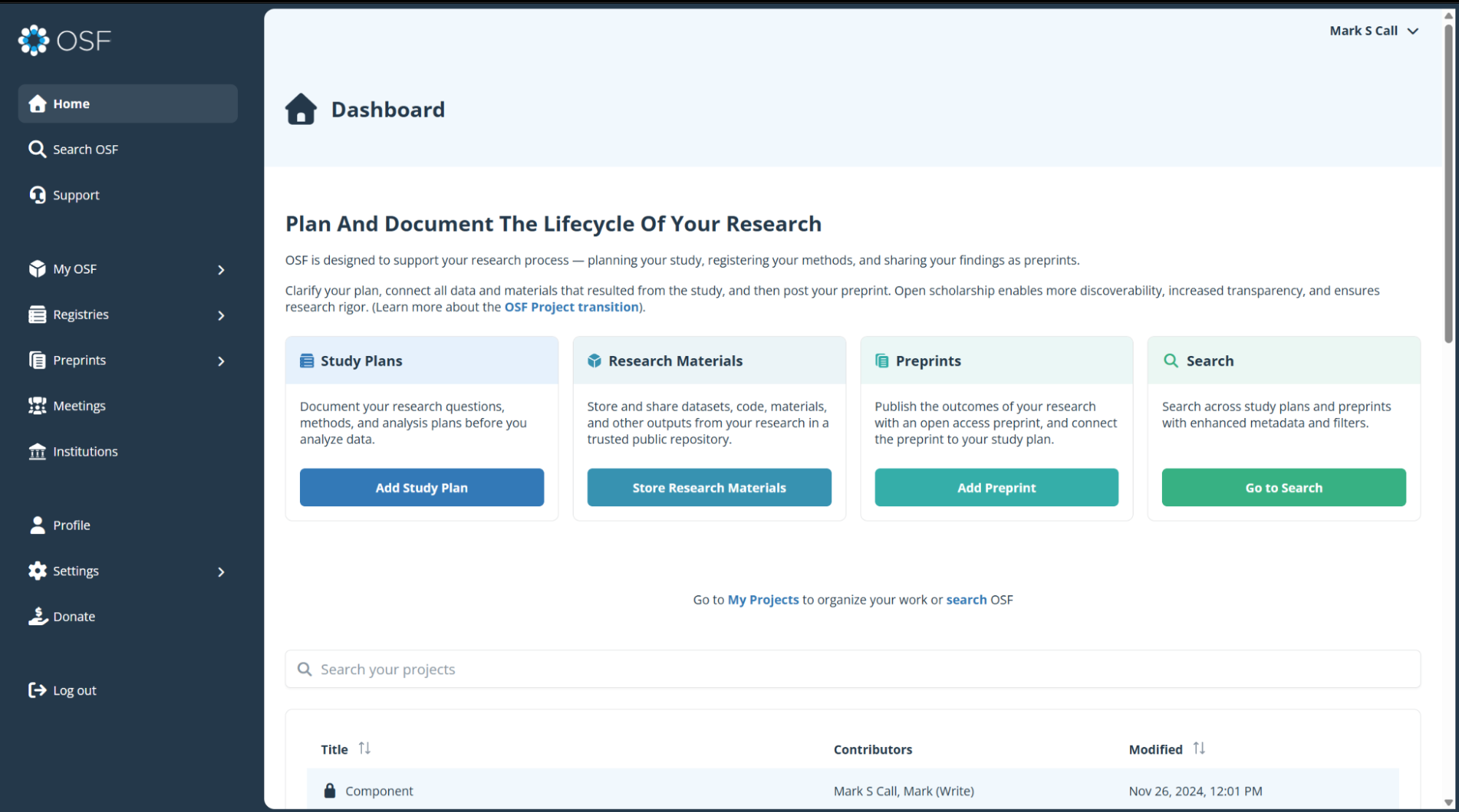
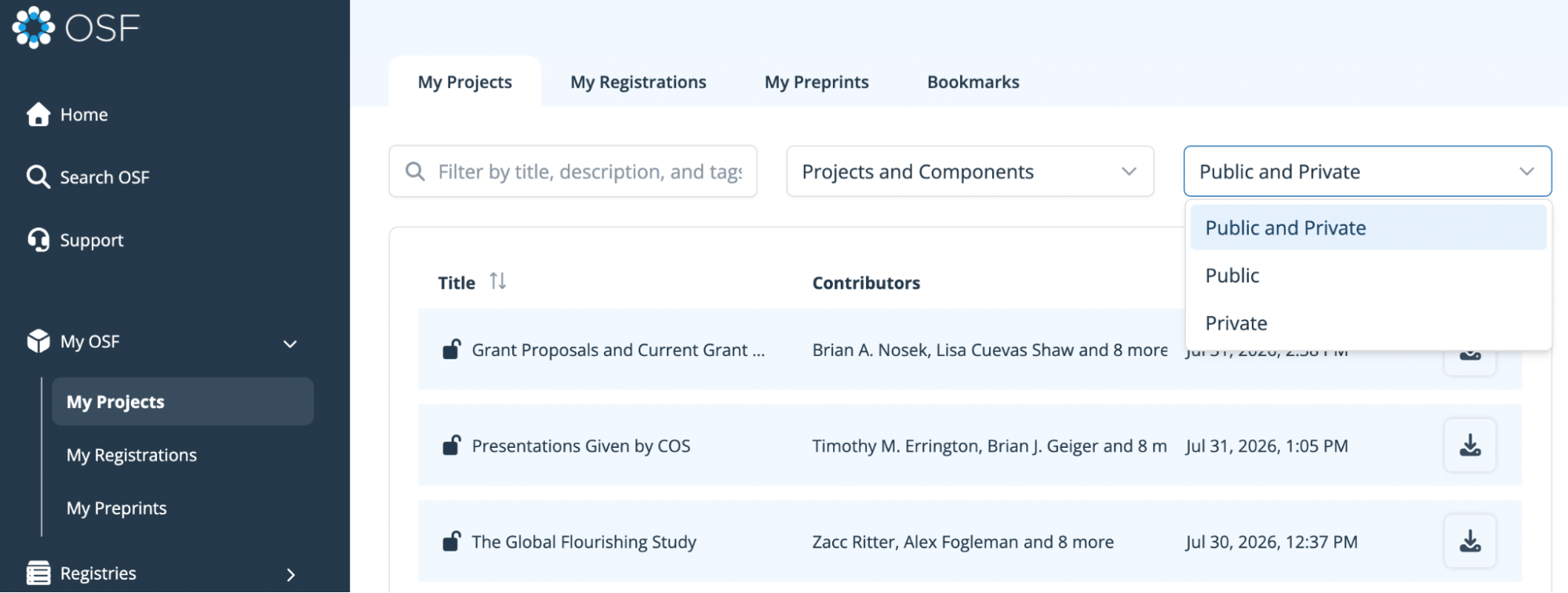
image5

Improved Download Efficiency

This update makes it easier and more efficient for OSF users to access and download their project content. Users can now download content directly from the My Projects and Project Overview pages, without navigating into individual projects or components and going to the Files tab.
image4

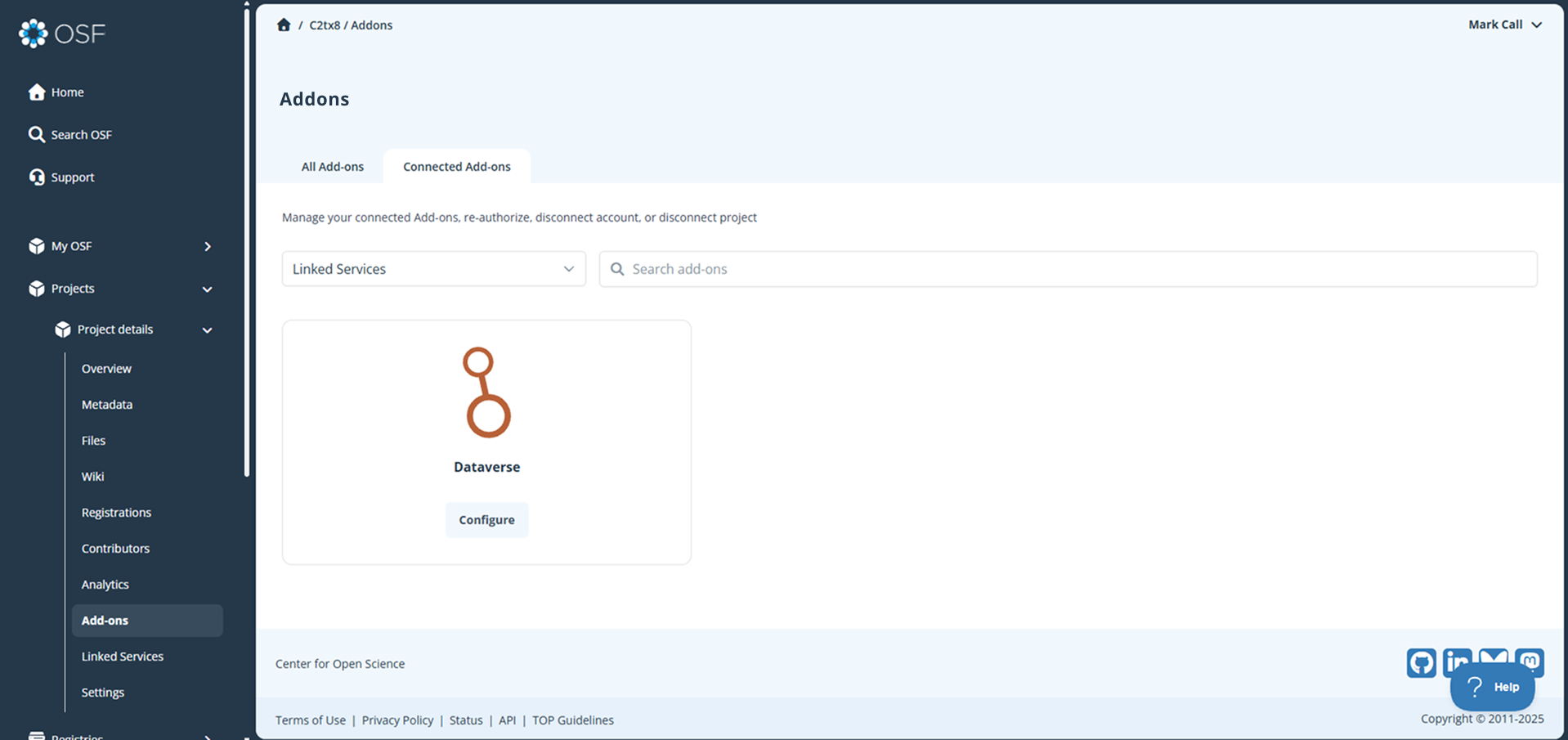
Linked Services Enable Integration Pathways

Integrating additional services into the OSF enables researchers to bring key parts of their workflow into the OSF platform. However, building and maintaining full-featured add-ons requires a significant development investment, often limiting who can create them and how widely they’re adopted. 

Linked Services offers a simpler, more scalable way to connect external tools to OSF. If you’re a developer or technically inclined and interested in building new integrations with OSF, we’d love to hear from you. Join our growing open source community by filling out this short interest form.
Export

We build in the open

Our vision is to make it possible and easy to do open science by providing the infrastructure and tools to easily implement open and rigorous practices across the research lifecycle.

The OSF and its suite of services are open source, and the code is fully visible to the community to view its continual development. We invite the communities OSF serves to contribute code and ideas to enhance functionality, and have peace of mind and security in knowing they will never be locked-in.

Open source code often has added benefits by its very nature, which make it more reliable and secure due to the increased review. Open source tools offer long-term viability due to a supportive community, transparency, and freedom from proprietary restrictions on research data and outcomes.

See Our Development in Action
Propose or Request Contributions

Preservation Statement

OSF is committed to the persistence of the scholarly record by ensuring that publicly shared research objects and their associated metadata remain persistent, discoverable, and accessible through sustainable strategies and persistent identifiers. 

As part of this strategy, OSF backs up preservation copies of public registrations through the Internet Archive and intends to extend comparable practices to public projects and preprints. To support long-term stewardship of the public OSF content, COS maintains a fund to ensure continuity should the platform need to transition in the future.