There are two ways you can get involved with this initiative, and you may participate in either or both activities:
If you are interested in joining this initiative, please complete the general interest sign-up form. If you have any questions, feel free to reach out by filling out the contact form below.


We are accepting general interest sign-ups until November 1, 2026. The current round of the initiative will focus on secondary data replications (e.g. use of existing longitudinal surveys, public health databases, or case surveillance systems). Replication sign-ups and funding will be approved on a rolling basis, so we recommend signing up as soon as possible to secure a replication study you are interested in. All replications must be completed and reported to COS by no later than December 1, 2026.
Sign-Up
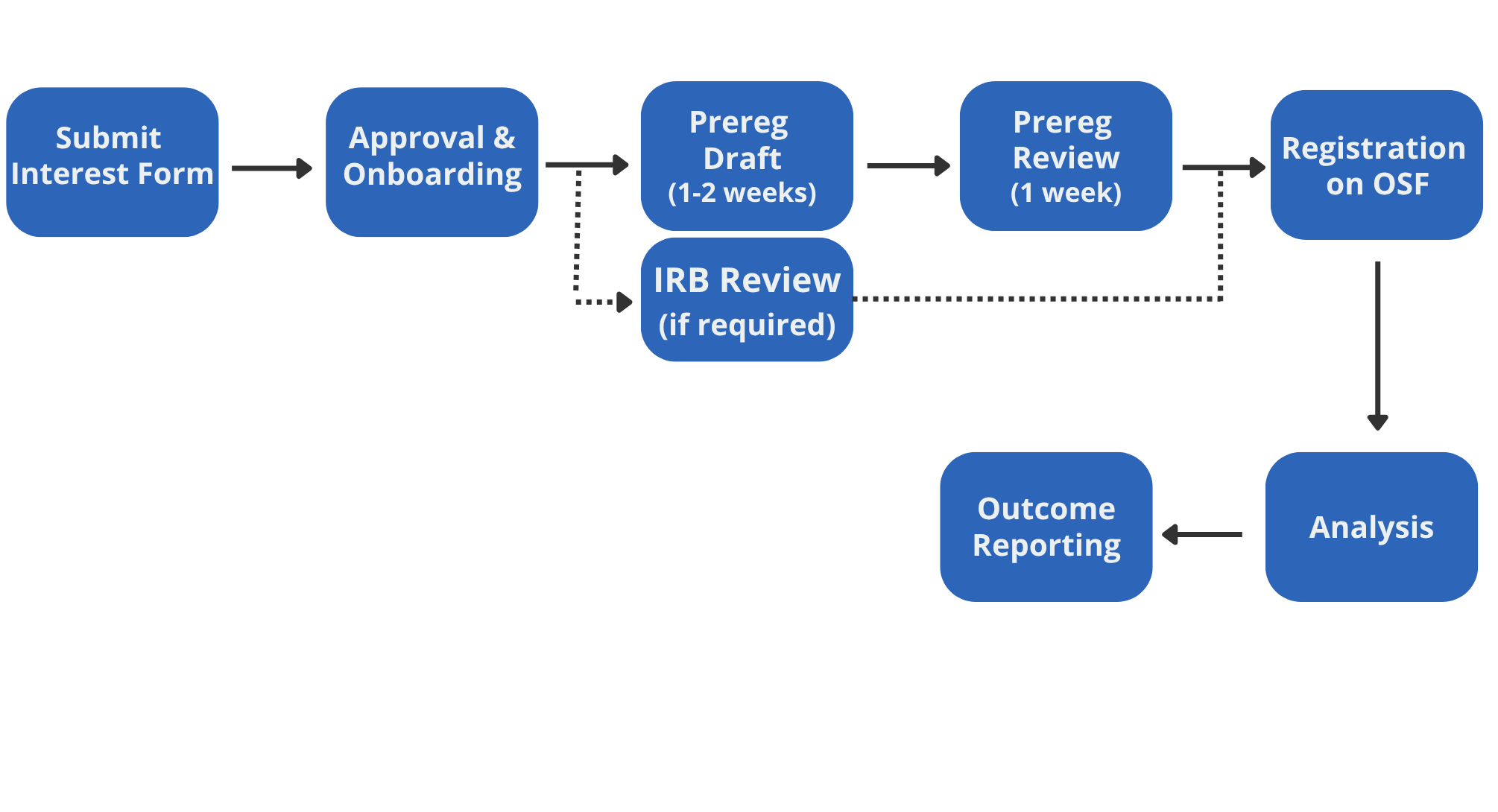
If you are interested in joining this initiative as a replicator, please begin by viewing the available replication studies on our replication sourcing sheet. To sign up for the replication(s) of interest to you, follow the link provided in row K. We will be in touch within a few days with additional information.
Approval & Onboarding
Once we confirm that the study you are interested in replicating is feasible given the projected timeline and budget, we will send you additional instructions and next steps to get started on your replication. One of the first steps will be signing an agreement through your institution in order to receive your honorarium once your replication is complete. You will also be asked to complete a priori analysis to estimate the approximate power of your replication study before completing your preregistration and carrying out your study. Templates and other resources you will need to carry-out your replication are provided on the RP:HB OSF project.
Preregistration & Ethical Review
If your study requires ethical review, you must submit your study for review via your local institution as soon as possible as you will need to receive approval before beginning data collection.
To foster transparency and careful planning, you will complete a preregistration of your replication protocol to document the details of your methodological and analytical approach. We will provide you with a template to use along with guidance on how to fill it out. After your preregistration draft is complete, it will go through a review process where peers will have one week to review and provide comments on your protocol. Once you have addressed the reviewers feedback, your protocol will be approved by an editor to move forward (pending ethics approval if required).
Following preregistration and ethical approval, you will register your study on the OSF (instructions will be provided).
Data Collection
You may begin data collection as soon as your study has been registered on the OSF. Please keep COS informed on the progress of your data collection, and let us know if you encounter any setbacks or difficulties with achieving your target sample size.
Analysis & Outcome Reporting
Once your study is registered on the OSF, you will be able to conduct your pre-planned analysis with the dataset approved by COS. Then you will complete a reporting form to document your outcomes, and upload all sharable outputs (including deidentified data) to a repository of your choice, linking your data, code, and materials to your OSF preregistration. A team member from COS will validate your outcomes and verify that you have linked your materials. All replication studies must be complete and reported to COS by December 1, 2026.

6218 Georgia Avenue NW, Suite #1, Unit 3189
Washington, DC 20011
Email: contact@cos.io

Unless otherwise noted, this site is licensed under a Creative Commons Attribution 4.0 International (CC BY 4.0) License.
Responsible stewards of your support
COS has earned top recognition from Charity Navigator and Candid (formerly GuideStar) for our financial transparency and accountability to our mission. COS and the OSF were also awarded SOC2 accreditation in 2023 after an independent assessment of our security and procedures by the American Institute of CPAs (AICPA).
We invite all of our sponsors, partners, and members of the community to learn more about how our organization operates, our impact, our financial performance, and our nonprofit status.