OSF enables researchers to register study plans, publish preprints through community-run services, and link externally to related data, materials, code, publications, and other results. OSF supports lifecycle open science by helping researchers openly document, connect, and share their research throughout the process.
OSF enables researchers and research communities to create a clearer, more durable record of their work by registering study plans, submitting preprints through community-run services, and linking related outputs and outcomes over time. This helps make more of the research process visible, not just the final paper.
Create a citable record of your research plans before a study begins. Registrations provide a clear point of reference for understanding how research developed over time.
Research communities can use OSF to operate preprint services that reflect their scope, policies, and disciplinary norms. Researchers can use those services to share outcomes earlier and more openly.
Connect study plans to research outputs and outcomes stored in specialized repositories and services, helping make research easier to find, understand, and assess.
Search public research records and identify connections to related data, code, materials, papers, and supplements.

OSF is evolving to work alongside the open research infrastructure that researchers already use. Future development will focus on making it easier to register study plans, link related outputs and outcomes across systems, and creating more complete, durable, and transparent research records.

Lifecycle open science makes the entire path of research—from initial study plans, to data code, analyses, and outcomes—publicly accessible, connected, and findable in a persistent, open location.
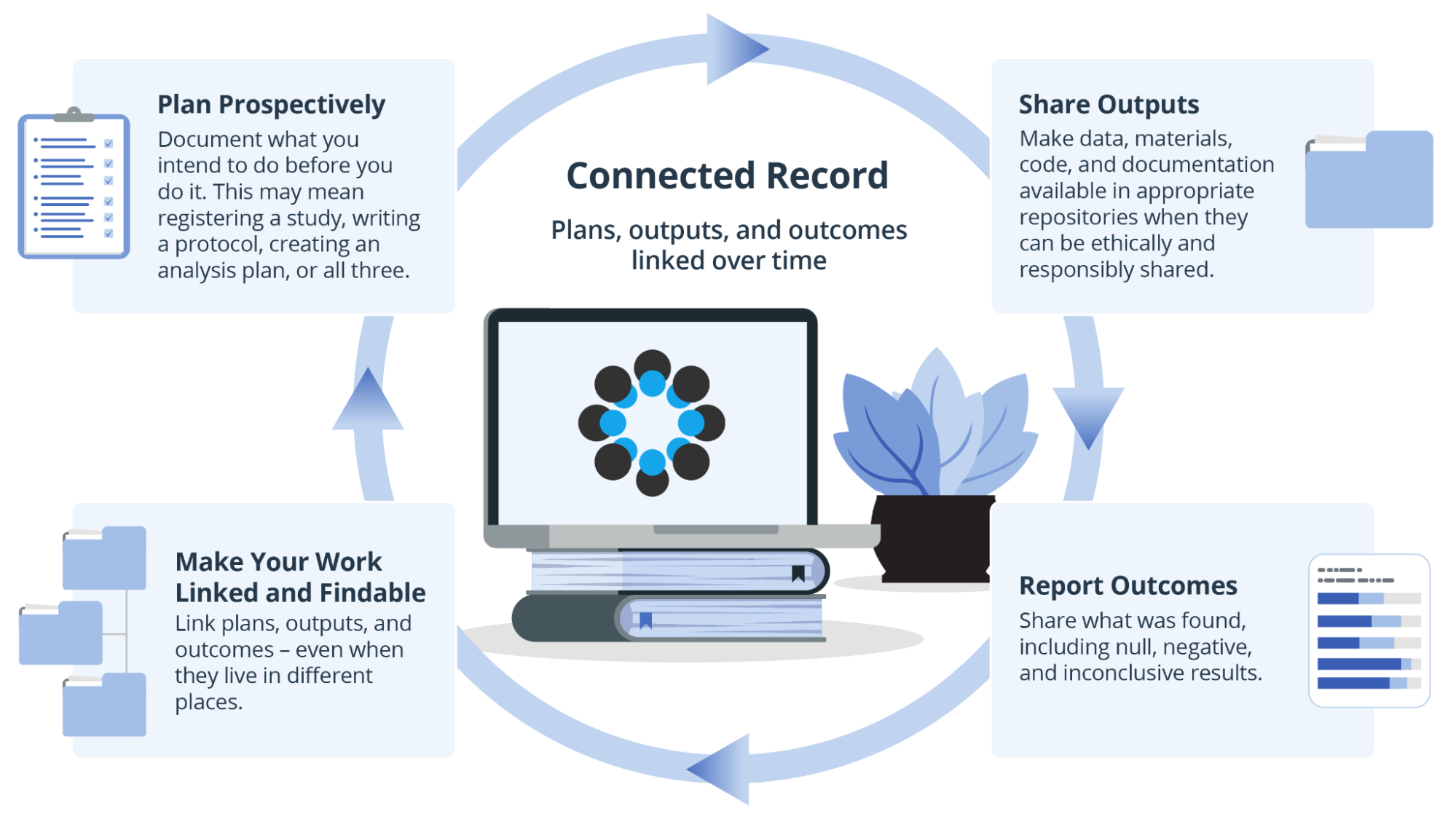
This approach makes the full path of research easier to see, assess, and build on, rather than treating the paper as the sole contribution to research. Others can better understand what was planned, what was produced, what was found, and how those pieces relate. Research becomes easier to evaluate, reuse, verify, and build on when those connections are visible.

OSF helps researchers connect study plans, research outputs, and outcomes across complementary research infrastructure, creating a more transparent and durable research record.

Analysis, code, and manuscript drafts change over time, and it is important to keep track of all these different versions. OSF makes it easy by automating version control for files with the same name.

Registrations create time stamped, read-only versions of a project. Use this to preregister a hypothesis and analysis plan, or keep a snapshot of work before peer review. Registrations can also be embargoed to stay private for a set period before becoming public.

OSF allows you to share what you want, when you want. Everything on OSF is private by default. Users have fine-grained control over which aspects of the project are made public.

OSF is built for interoperability with the specialized tools and platforms that researchers already use—like Zenodo, Dryad, and Dataverse—so your data, code, and materials stay linked to your OSF study record.

OSF supports preregistration templates developed by and with research communities to help researchers document study plans in ways that reflect disciplinary practices while promoting transparency and consistency.


6218 Georgia Avenue NW, Suite #1, Unit 3189
Washington, DC 20011
Email: contact@cos.io

Unless otherwise noted, this site is licensed under a Creative Commons Attribution 4.0 International (CC BY 4.0) License.
Responsible stewards of your support

COS has earned top recognition from Charity Navigator and Candid (formerly GuideStar) for our financial transparency and accountability to our mission. COS and the OSF were also awarded SOC2 accreditation in 2023 after an independent assessment of our security and procedures by the American Institute of CPAs (AICPA).
We invite all of our sponsors, partners, and members of the community to learn more about how our organization operates, our impact, our financial performance, and our nonprofit status.